









 Twitter
 Facebook
 LinkedIn
 Flickr
 Stairs
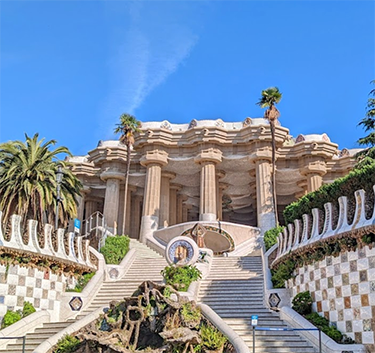
We rarely stop and think about stairs. We walk them every day, rushing up, dragging ourselves down, skipping steps when we’re late. But stairs are never just movement. They are experiences. A stair is one of the oldest architectural elements, dating back thousands of years, created simply to bridge height step by step. Stairs originally were in tight vertical ascents off the side of major spaces. They might rise up to ring the bells of a church. Yet somehow, this simple idea became one of the most powerful spatial tools we have. Stairs connect levels, yes, but they also connect moments, emotions, perspectives, and views outside Think about it. The way you enter a building, the way you pause halfway, the way you turn and look back, stairs shape all of that. They are not just circulation. They are storytelling in motion. So instead of asking “how do we go up?”, let’s ask something more interesting: what can a stair make us feel?
Go up the down staircase!
Activity 1 – famous stairs

Some stairs are so powerful, they become destinations on their own. You don’t just use them, you remember them. Think of the Spanish Steps in Rome leading to, where the city unfolds as you climb. Or the dramatic stair inside the Paris Opera, where movement becomes performance. Even in academic spaces, like the Laurentian Library designed by Michelangelo, the stair feels almost alive; flowing, sculptural, unexpected. These stairs are not efficient. They are intentional. They slow you down, make you look around, and invite you to experience space differently. That’s the difference between a stair that is strictly functional and a stair that speaks. Search for a famous staircase and sketch it quickly. Don’t focus on details; focus on how it feels. Laurentian Library Chateau Chambord Stairs Spanish Steps Paris Opera Stairs
Activity 2 – Treads and Risers

Every step you take on a stair is carefully designed, even if you don’t notice it. A stair is made of repeating elements: the part you step on (the tread) and the vertical part between steps (the riser). Together, they create rhythm. And that rhythm controls your body. If the proportions are right, walking feels natural. If not, something feels off immediately. Designing stairs is actually a mathematical exercise as much as it is architectural. The height and depth must work with human movement, balance, and comfort. That’s why badly designed stairs feel awkward, even unsafe. Look at a stair near you. Count the steps and observe the proportions. Does it feel comfortable? Why or why not? Draw along with this video of stairs.

Activity 3 – Stair Types
Not all stairs move the same way. Some are straight, direct, and honest, taking you from one level to another with no distractions. Others turn, split, or fold, guiding movement through space. Some wrap around themselves, creating layered experiences as you go up.
Architecturally, the choice of stair type changes everything. A straight stair is efficient, but it reveals vertical ascent or descent at once. A turning stair creates moments, pause, turn, discovery. A split stair can separate flows of people, while still connecting them visually. Stairs are geometry in motion. They shape how we navigate space, how we meet others, and how we understand a building. Draw a simple plan of a stair you use often. Is it straight, turning, or something more complex?
Activity 4 – Spiral Stairs

There is something almost magical about spiral stairs. They twist, rise, and pull you inward. Unlike straight stairs, they don’t just connect two points; they create a journey. Historically, spiral stairs appeared in temples, castles, and towers, often compact and efficient, but also deeply symbolic. Today, they are often used as architectural statements. Some feel heavy and enclosed, others feel light and floating, almost impossible, like they shouldn’t exist. Floating or cantilevered stairs even appear to hover in space, challenging gravity itself. Spiral stairs are where engineering meets art. They are not just functional, they are emotional. Take a photo (or find one) of a spiral stair and trace its movement path. How does your eye travel through it?
Activity 5 – Railings

Railings are often treated as secondary, but they shouldn’t be. They are the line your hand follows. The edge that defines space. The detail that can transform a stair from ordinary to extraordinary. A railing can be heavy and solid, making you feel secure. Or it can be transparent, almost disappearing, making the stair feel open and light. Materials matter, wood feels warm, metal feels precise, glass feels invisible. Good railing design balances safety with experience. It protects you, but it also shapes how you perceive the stair. Next time you use stairs, pay attention to the railing. Do you touch it? Ignore it? Why?
Activity 6 – City Stairs

In some cities, stairs are not just inside buildings; they are the city. Think of hillside cities where streets turn into stairs, connecting neighborhoods vertically instead of horizontally. In places like these, stairs become public space. People sit, talk, rest, and observe life happening around them. These stairs are not just about movement; they are about community. They slow people down, create interaction, and shape the rhythm of everyday life. Even today, architects are rethinking stairs in public spaces. Some are designed as seating, gathering zones, even learning environments where people sit, study, and connect. Stairs are no longer just for going up; they are places to stay. Find an example of outdoor city stairs. How are people using them besides walking?
Activity 7 – Stairs that You can Read!

Sometimes stairs do more than carry the body, they also carry a message. In many buildings and public spaces, designers use stairs as a surface for words, numbers, graphics, or patterns that people can “read” while moving. A stair can become a poem, a warning, a map, a lesson, or even a playful visual surprise. This changes the stair from a simple architectural element into a communication tool. What makes this interesting is that reading a stair is never the same as reading a wall or a page. You only understand it through movement. One step reveals part of the message, then the next step completes it. In that sense, the stair becomes interactive. Architecture and graphic design begin to work together, and the person climbing becomes part of the composition. Find an example of stairs with words, colors, or graphics on them. Save a photo or sketch your own idea for a stair that communicates a message.
Review
- Stairs are not only for circulation; they can also shape experiences, emotions, perspectives, and views.
- Famous stairs can become destinations that people remember, not just elements they use.
- The tread of the stair is the vertical riser between steps.
- A turning stair can create moments of pause, turning, and discovery.
- Railings can affect how safe, open, heavy, or light a stair feels.
- City stairs can become public spaces where people sit, talk, rest, and observe life.
- Stairs with words, colors, or graphics can communicate messages while people move through them.
- Early church stairs were often circular as they connected the sanctuary with Bell Towers.
- Stairs can be interior as well as exterior
Explore
- Atlas Obscura Spiral Stairs
- Engineering of a Helical Stair
- History of Stairs
- History of Stairs and Stair Types Photo Gallery
- Khan Academy Garnier Paris Opera Stair
- Khan Academy Michelangelo's Laurentian Library
- M.C. Escher...math and stairs!
- Musical Stairs Video
- Staircases
- Stairs: An Architectural Obsession
- The Loretta Chapel Stair
- Video Fast Line: Sliding on Stairs!
Relate










All contents copyright © NEXT.cc. All rights reserved. Terms of Use